
Compass Cases logo
Compass Cases logoCompass CasesCase Five · Ruth’s Way Home
Case Five

Ruth’s Way Home

A fall in the night, a broken hip, and the wide circle of people who help an 85-year-old woman fight her way back to her own kitchen table.

Portrait of Ruth
This case is a journey. First, see how the people in Ruth’s care are arranged around her. Then read her story straight through. Then walk her road: five stages, from the night of the fall to the road ahead, and at many stops you will make a real decision before you read a word.
Draft for review: the clinical story follows real geriatric practice, and the career details are carefully researched and awaiting practitioner verification.
Before you begin

Everyone stands somewhere around Ruth

Every Compass Case sorts its people into four rings, arranged by how close their work brings them to the patient. Watch them appear.

Ruth is at the center.

Press Continue to draw the first ring around her.

Systems, science & public health
Extended care team
Family & community
Direct clinical care
Ruth
Part One · The Story

What happened to Ruth

Read this once, straight through, before you meet anyone. Everything that follows grows out of it.

The night

Ruth Mason is 85. She is a retired school librarian, widowed six years, and she lives alone in the house she and her husband bought fifty-two years ago, four towns from her eldest son Mark, who calls every Sunday after church. She still drives to the library and to choir practice on Thursdays. She has a cat named Earl and a kitchen table where everything important in her family has ever happened. When anyone asks what she wants for the years ahead, her answer has been the same for six years: to stay in her own home.

Her medicine cabinet tells a longer story than she would. Three pills for blood pressure. A thyroid pill she has taken for thirty years at a dose no one has rechecked in ten. A bone medicine she quit because it bothered her stomach, after a broken wrist at 78 that everyone, including her doctors, treated as bad luck. And a pink over-the-counter sleep aid on the nightstand, because she read somewhere it was gentle. Nine pills a day, counting supplements, prescribed by three different clinicians who have never spoken to each other.

Tonight, a little after two in the morning, the tea she had with dinner and the water pill she takes at six make themselves felt. Ruth wakes, sits up, and stands the way she has stood up her whole life, in one motion. The room tilts. Three blood pressure medicines and an antihistamine arrive ahead of her. In the dark hallway her slipper catches the leg of the wooden chair that has stood in that same spot for decades, and she goes down hard on her left side.

The pain in her hip is unlike anything she knows. She cannot stand. The phone is in the kitchen.
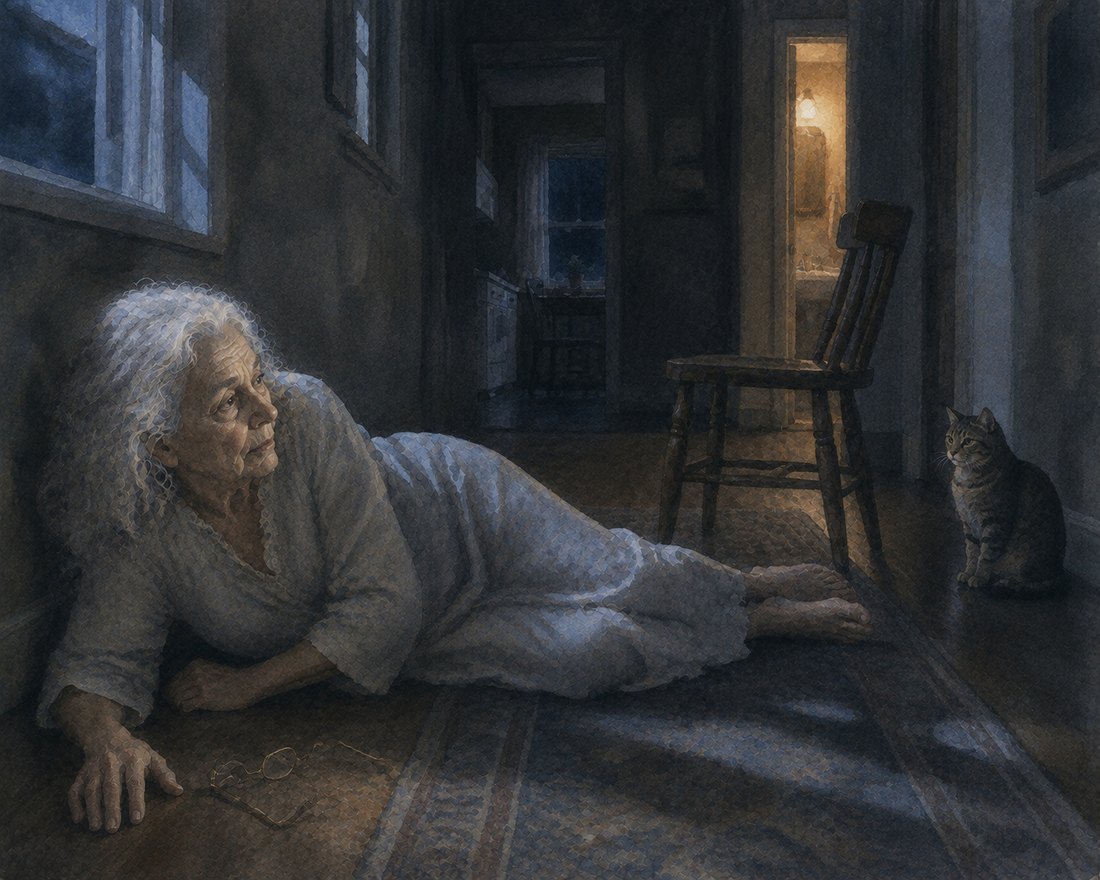
Watercolor: seen from floor level, Ruth lies on her side on the hallway rug of her old house in a pale nightgown, her gold-rimmed glasses fallen beside her open hand, the wooden chair she tripped on standing over her and Earl the gray tabby sitting upright a few feet away, watching.
2:10 a.m. Earl stays. Her glasses where they fell, the chair she tripped on still standing, and the phone a room away. Watercolor illustration, AI-generated.
Three hours

What happens next is the part of this story medicine has a name for and most people have never heard of: the long lie. Ruth is on the floor for almost three hours. The cold comes up through the floorboards first. Then the shaking. Muscle pressed against a hard floor for hours begins, quietly, to break down. Earl sits beside her in the dark, which helps and does not help.

She crosses the hallway the only way she can, a few inches at a time, resting between efforts. At five in the morning she reaches the kitchen doorway, pulls the phone down from the counter by its cord, and dials 911. The voice that answers stays with her, calm and steady, until the ambulance crew is through the door she talked them into unlocking with the hidden key. She will tell Mark later that the voice on the phone was the first hand that reached her.
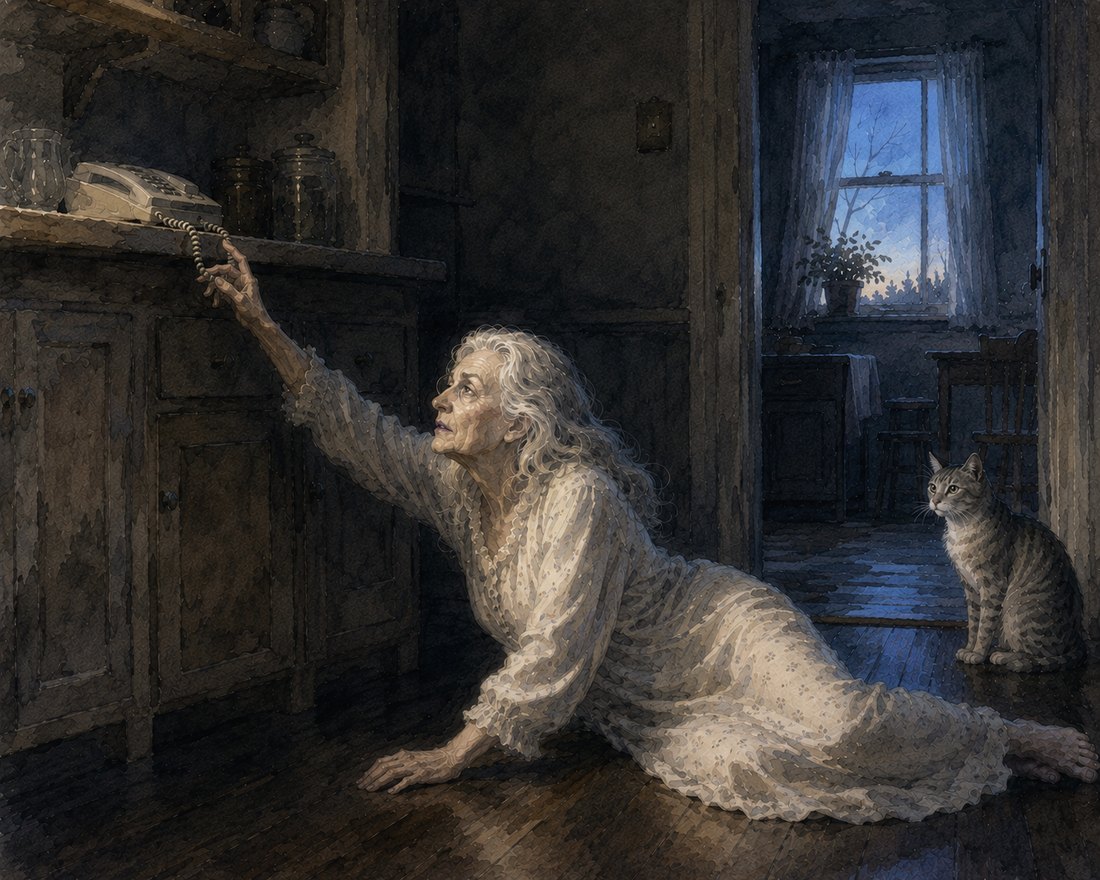
Watercolor: just before dawn, Ruth lies on the kitchen floor in her nightgown, propped on one elbow, one arm stretched up to a corded telephone on the counter, her fingertips catching the cord while Earl the cat watches from the doorway.
5:00 a.m. Three hours to cross one hallway, and the cord is the only way to reach the phone. Watercolor illustration, AI-generated.
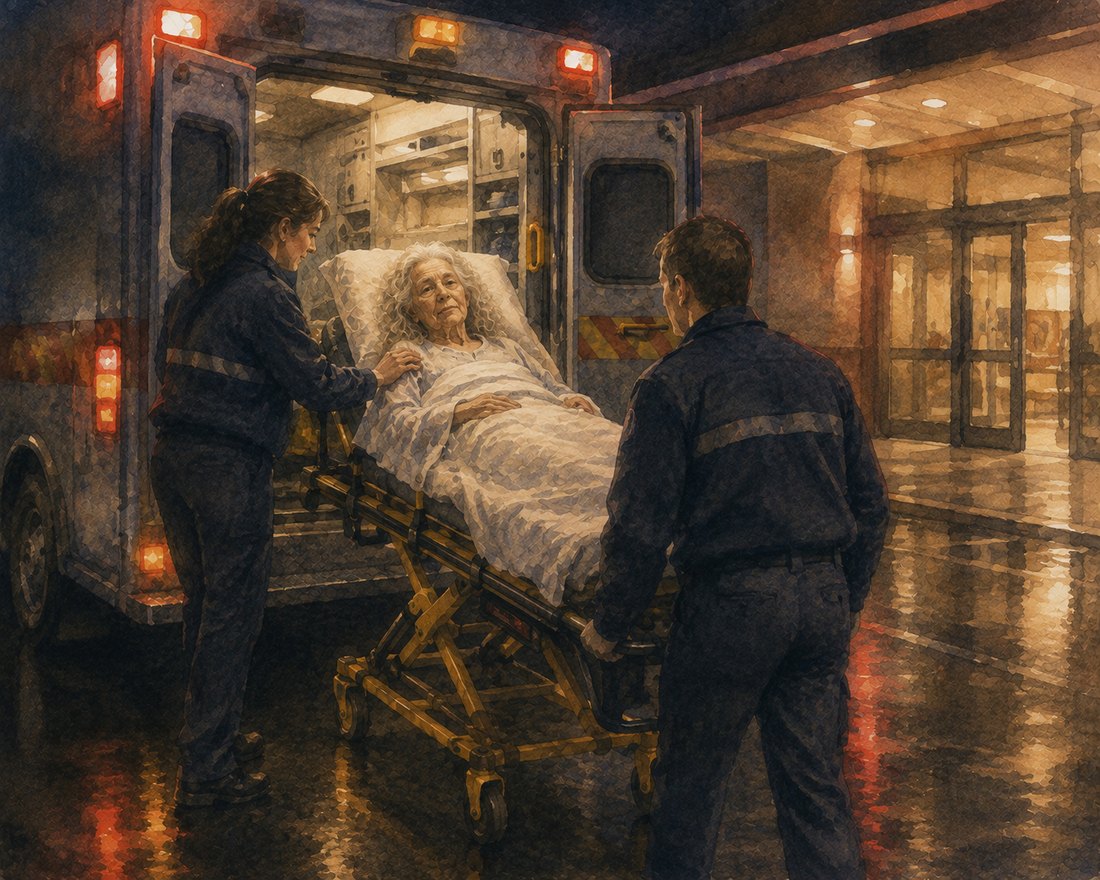
Watercolor: on wet pavement outside a lit hospital entrance, two ambulance crew ease Ruth's stretcher out of the back of the ambulance, one with a hand on her shoulder, her face calm and lit under a warm blanket.
5:40 a.m. The county hospital’s emergency entrance. Two strangers in dark uniforms, a warm blanket at last, and the doors about to open. Watercolor illustration, AI-generated.
The hospital

The X-ray at the hospital shows what the emergency team already suspects from the way her left leg lies: the neck of her thigh bone, just below the ball of the hip joint, has snapped, and the pieces have shifted. At 6 a.m. a phone rings four towns away, and Mark hears the sentence every adult child of an aging parent is braced for and never ready for.
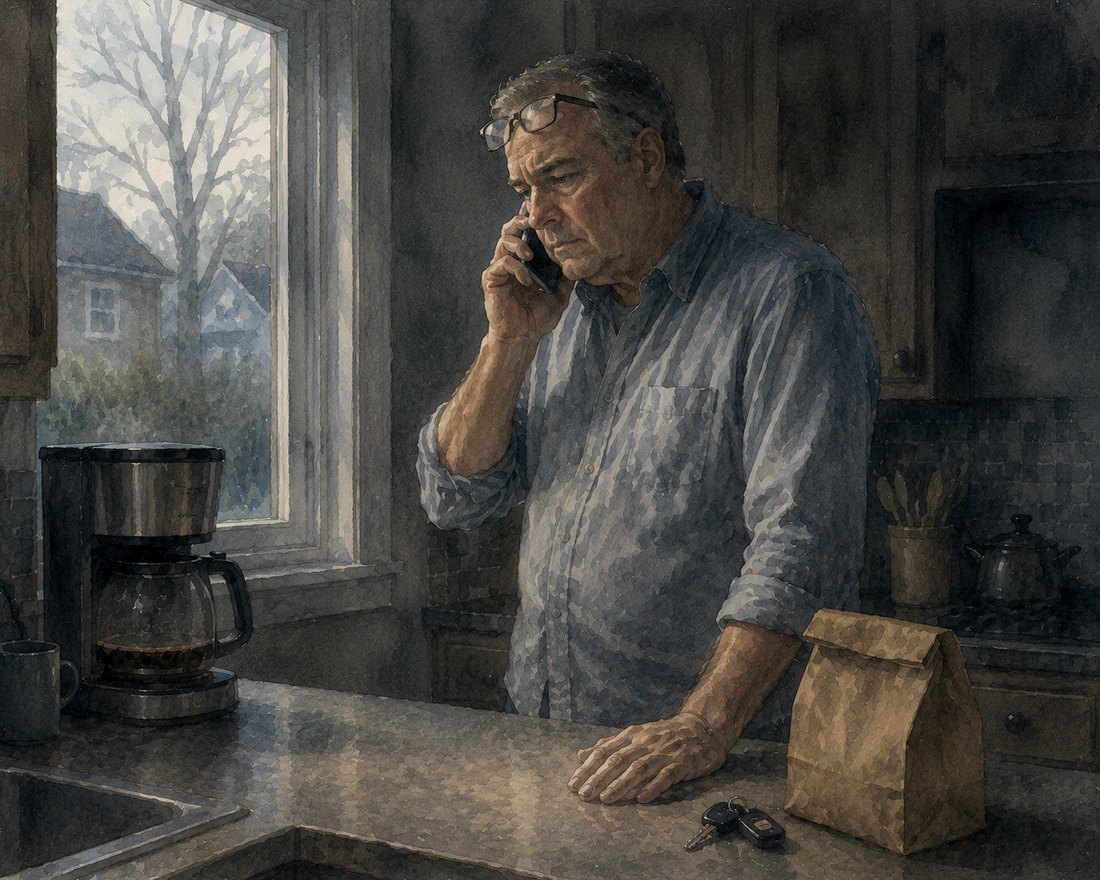
Watercolor: at six in the morning in a suburban kitchen, Mark stands very still with a phone to his ear, one hand flat on the counter, a coffee maker mid-cycle and his car keys forgotten beside him.
6:00 a.m., four towns away. The sentence every adult child is braced for and never ready for. Watercolor illustration, AI-generated.

Within thirty-six hours Ruth is in an operating room. The surgeon replaces the broken ball of her hip with a metal one, a choice made carefully for a woman of 85 with bone that has been thinning for years, because it lets her put weight on the new hip immediately. Anesthesia is its own careful conversation: she stays awake-but-numb from the waist down, lightly sedated, at the recommendation of a doctor who sat with her for four minutes beforehand and won her trust.
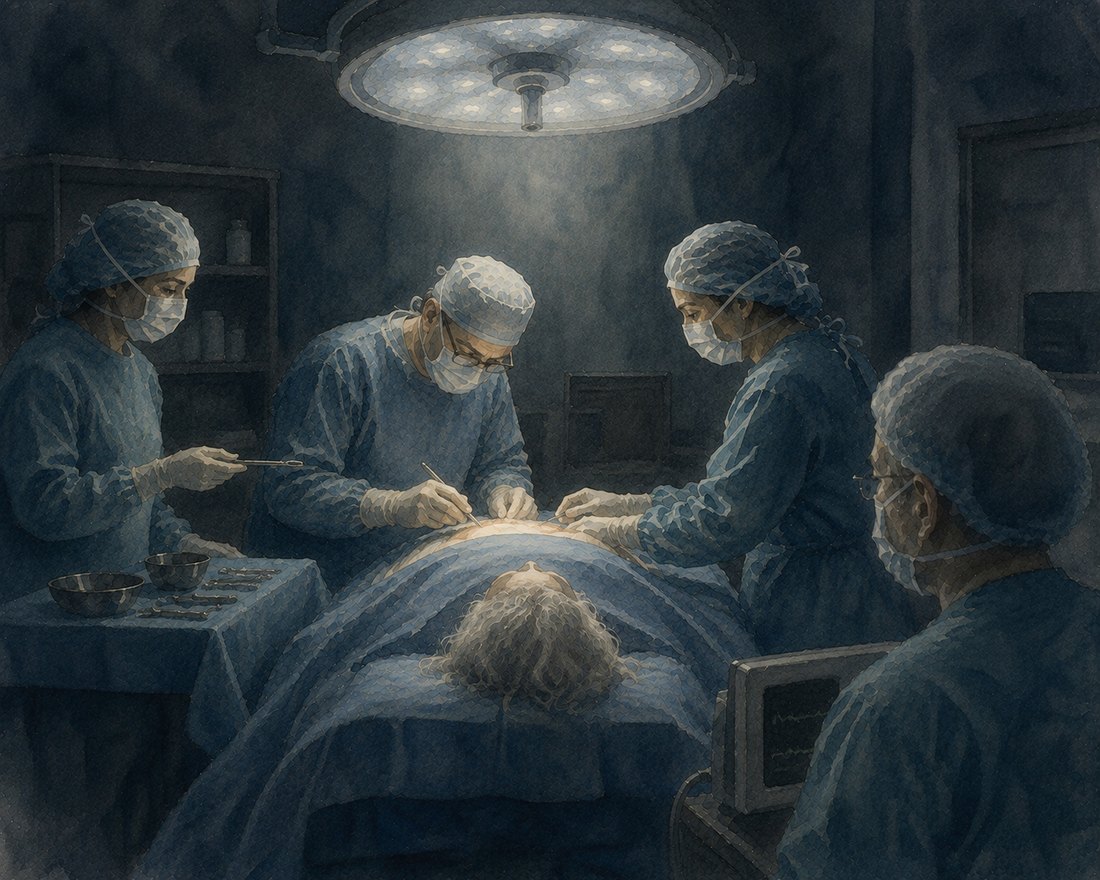
Watercolor: an operating room seen from the head of the table, cool blue-green light from the surgical lamp, a small elderly woman draped in sterile blue with her face turned away while four gowned and masked figures work calmly around her.
Within thirty-six hours. A metal ball replaces the broken one, so she can stand on it the next day. Watercolor illustration, AI-generated.

In the recovery room a nurse watches her blood pressure and, just as closely, her thinking, because in someone Ruth’s age the days after surgery can bring a dangerous, temporary confusion called delirium. One night it flickers: at 2 a.m. she speaks to her late husband. The nursing assistant who hears it writes it down, and the team adjusts by morning.
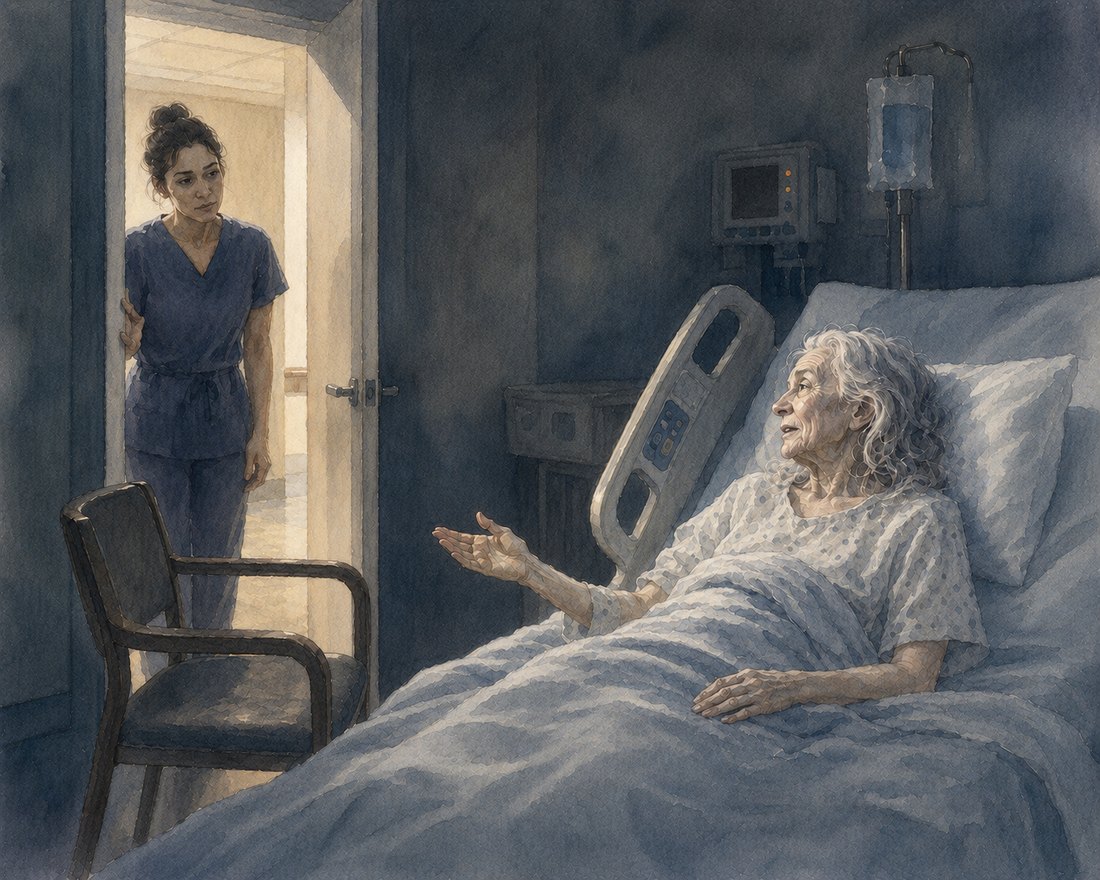
Watercolor: a darkened hospital room at two in the morning, Ruth propped up in bed speaking gently toward an empty chair, while a young nursing assistant in dark scrubs stops in the lit doorway to listen.
2 a.m., three nights later. She is talking to her husband, and the least credentialed person in the building is the one who notices. Watercolor illustration, AI-generated.
Rebuilding, somewhere that is not home

Surgery repairs a bone. It does not give back the strength, the confidence, or the three hours on the hallway floor. For that, Ruth moves to a skilled nursing facility, a place almost no student has seen the inside of, where the real work of her recovery happens: bed to chair, chair to hallway, hallway to handrail, morning after morning, led by a therapy team and watched over by nurses and aides who know her coffee order by day three.
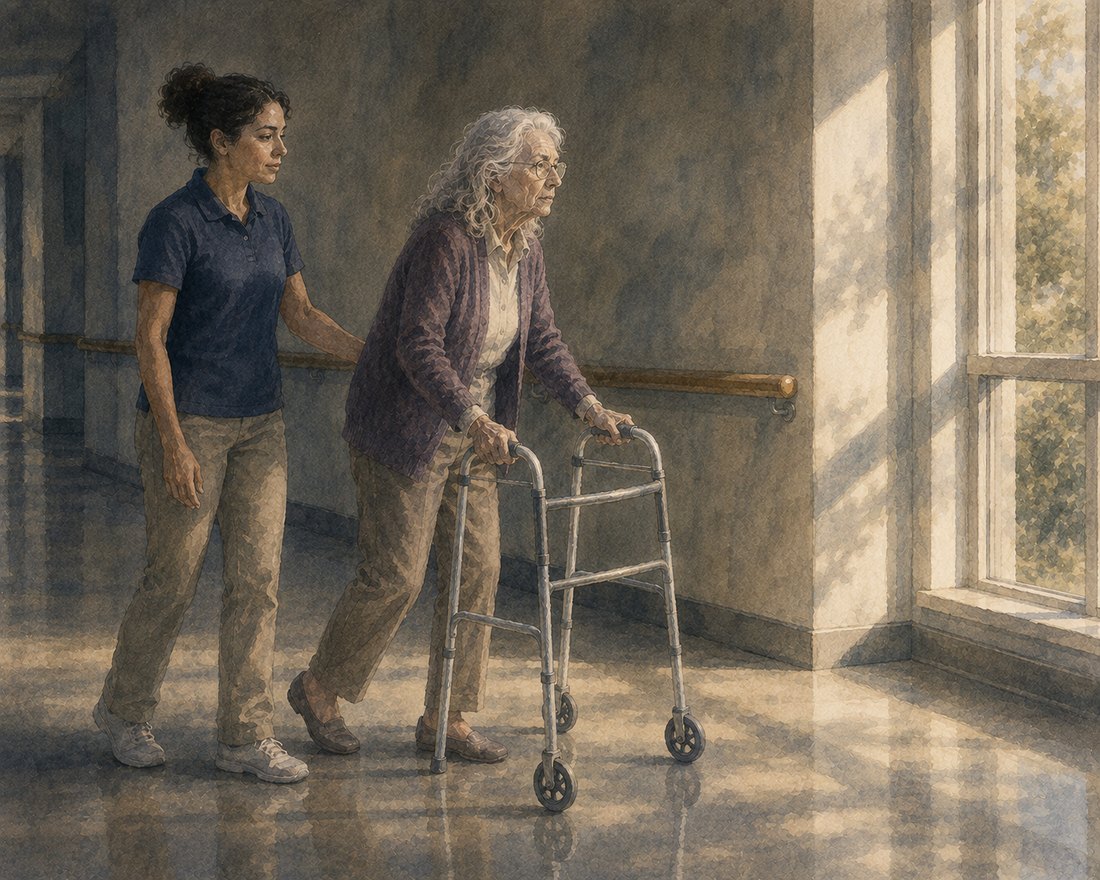
Watercolor: a wide rehabilitation corridor in bright morning light, Ruth in profile behind a wheeled walker with one heel lifted mid-step, a therapy assistant walking beside her with one hand hovering near her waist.
Week two. Bed to chair, chair to hallway, hallway to handrail, morning after morning. Watercolor illustration, AI-generated.

It is here that a geriatrician, a doctor whose specialty is people like Ruth, reads her medication list the way a detective reads a room, and asks the question that reorganizes this whole case: which of these medicines helped put her on the floor? Two of them come off the list that week. Her standing blood pressure, measured in the hallway with a nurse at her elbow, stops dropping. The 2 a.m. bathroom trips fade. Nobody had ever measured her blood pressure standing up before.

The way home

Getting Ruth home is an engineering project, and most of the engineers are people she has never heard of. A care manager Mark hires, because he is four towns away with a job and teenagers, turns forty phone calls into one plan. A home health nurse audits the medicine drawer at her kitchen table. A contractor who specializes in helping older people stay in their homes installs grab bars and better lighting, and moves the chair. A volunteer brings a hot lunch five days a week and, without ever calling it that, checks that she is okay.

And at last, someone connects the dots her chart had been holding for seven years: the wrist at 78 and the hip at 85 were the same disease talking, twice. A fracture liaison nurse, a bone density scan, and a specialist visit later, Ruth’s osteoporosis is finally being treated, her thyroid dose is finally right-sized, and the fracture that took her hip has become the reason the next one may never happen.

This case ends where Ruth insisted it would: at her kitchen table, with Mark on a video call and her doctor listening, saying out loud what matters most to her, and hearing the plan bend around it.
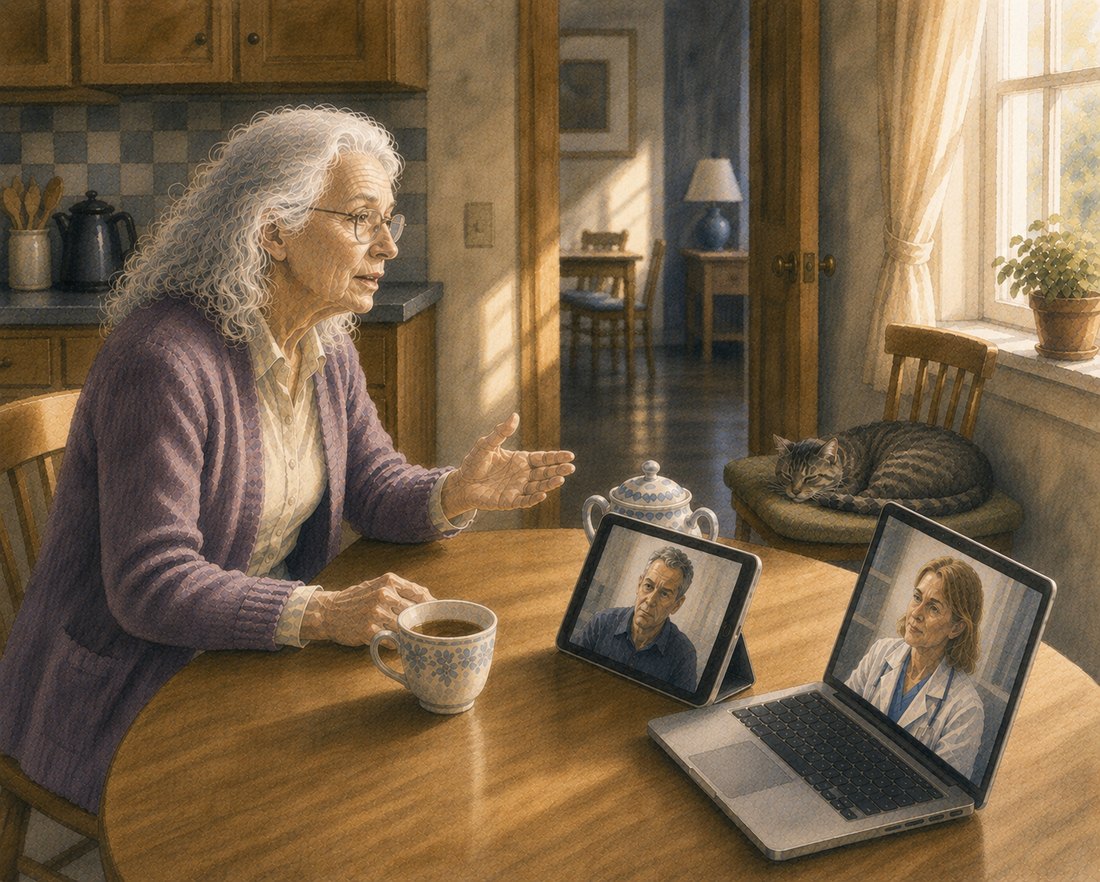

Watercolor: Ruth at her own kitchen table in late afternoon light, mid-sentence with one hand open, a tablet propped against the sugar bowl showing her son and a laptop showing her doctor, Earl asleep on a cushion behind her.
Her own kitchen, at last. Mark on the tablet, her doctor on the laptop, and Ruth running the meeting. Watercolor illustration, AI-generated.

The 5 M’s: how geriatricians think

Doctors who specialize in older adults organize care around five words. You will see these five badges on the stops ahead; tap any badge to see its meaning again.

MobilityMoving safely, and what happens when you can’t.
Moving safely, and what happens when you can’t. The fall, the three hours on the floor, the walker, the fear of falling again.
MedicationsThe right drugs, the right doses, and the courage to stop some.
The right drugs, the right doses, and the courage to stop some. Three pressure pills plus a sleep aid, and the decision at the heart of this case.
MindMemory, mood, and clear thinking.
Memory, mood, and clear thinking. The 2 a.m. confusion after surgery, the sedating sleep aid, the loneliness nobody coded for.
MulticomplexitySeveral conditions, several clinicians, several places of care, all interacting.
Several conditions, clinicians, and places of care, all interacting. Bones, thyroid, blood pressure; hospital, nursing facility, home; three prescribers who have never met.
Matters MostThe patient’s own goals steering every decision.
The patient’s own goals steering every decision. Ruth’s kitchen table. Every stop on this road either moves her toward home or away from it.
Part Two · The Journey

Walk Ruth’s road, stage by stage

Her road has five stages, all open: walk them in order to follow the story, or jump wherever your curiosity points. At most stops you will make a call before you read a word.

Family & communityThe ring that carries her: Mark, a volunteer at the door, the people of her town. Direct clinical careThe closest ring: the people whose hands touch Ruth. Extended care teamPeople Ruth may never see, whose work shapes every hour of her care. Systems, science & public healthThe outermost ring, working at a distance: programs, evidence, and the systems that catch what one clinician can’t.
The end of Ruth’s story, her six-months-later epilogue, the 5 M’s challenge, and the whole ecosystem unlock when you finish Stage V, or skip ahead with the button above.
Epilogue

Six months later

Watercolor: in a warm church hall on a spring evening, Ruth stands singing in a small choir, hymnal held in both hands and chin lifted, a wooden cane hooked unused over the back of the chair beside her.
Thursday evening, six months later. The cane is on the back of the chair she is not using. Watercolor illustration, AI-generated.

It is a Thursday evening in April, and Ruth Mason is standing with the altos, her cane hooked over the back of the chair she is choosing to stand beside. Her voice is where she left it. Choir was the first thing she asked the therapy team about and the last thing she got back, and the getting-back took a walker, then a cane, then a Tuesday in March when she walked the church hallway with the cane swinging, unused, in her hand.

The house has changed in small ways she has stopped noticing. The wooden chair lives in the bedroom corner now. A night-light traces the path from her bed to the bathroom, and grab bars wait by the toilet and the tub. The pill organizer on the kitchen table holds five medicines where there were nine; her blood pressure, measured standing, is fine. A bone medicine arrives by infusion twice a year, and her thyroid dose finally matches her age.

Mark still calls on Sundays. Now there is also a Wednesday text, a photo of a grandchild or the crossword, and Ruth answers with pictures of Earl, who has reclaimed the hallway. On the calendar by the refrigerator, in her librarian’s handwriting, Thursdays say choir, Mondays say tai chi at the senior center, and one Friday in June says, underlined twice, DEXA scan, ask about the wrist.

It took twenty-four people to get her here. She sends the ones she can reach a card at Christmas, and she has told the story of the voice on the phone so many times that her choir director finally asked for the dispatcher’s name. It is Priya. Ruth wrote to the county to make sure someone told her how the story ended.

The 5 M’s challenge

You met the 5 M’s before the journey. Now prove you can see them in the wild: here are six moments from Ruth’s story. Sort each one into the M where a geriatrician would file it.

The whole ecosystem

Here is everyone you just walked past, gathered into the four rings you saw drawn around Ruth at the start. Click a name to revisit them.

Filled dots are people you have already met. Click any name to revisit them.

It took 24 people, and many more behind them, to get one woman back to her own kitchen table.

Now find your own direction

Which of these ways of working feels most like yours: hands-on or behind the scenes, in the emergency or in the long recovery, with one patient or with a whole system? Who would you want to talk to in real life, and what would you ask them?

Open the Career Compass → Reflect on your experience →

Next steps on your journey

Every question you jot down along the road gathers here, so you leave with a list of real people to find and real questions to ask them.